
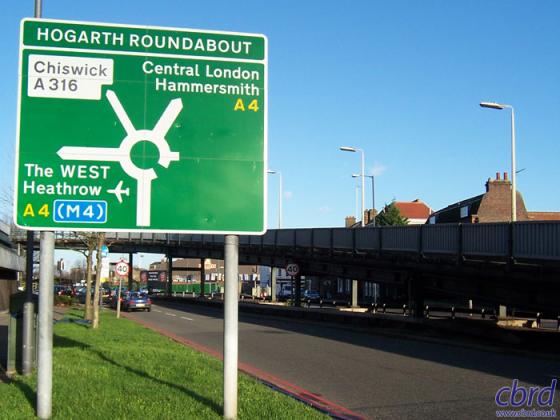
Residents of Old Chiswick, encompassing Chiswick Mall and the area between the River Thames and the A4 east of Hogarth Roundabout, have voiced strong opposition to Transport for London's (TfL) proposed changes to the road layout at Hogarth Roundabout.
The plans, which include blocking off Church Street as an entry and exit route, have been labelled as 'impractical and unnecessary' by the local community. TfL's initiative aims to enhance safety at the roundabout, particularly for motorcyclists navigating the turn onto the A316 near the George and Devonshire pub.
Currently, the entrance to the A316 is sufficiently wide for two vehicles, but it quickly narrows, leading to frequent jockeying for position. According to TfL data, six motorcyclist collisions occurred at this junction between July 2020 and June 2023, alongside two serious vehicle collisions, placing Hogarth Roundabout among the top 10% most hazardous junctions in London.
The Old Chiswick Protection Society, representing local residents, argues that the proposed changes would 'inflict direct harm on the wellbeing and safety of approximately 55 households and businesses' situated on Church Street and a significant portion of Chiswick Mall.
The proposed modifications include the creation of a dedicated left-turn lane for A4 westbound traffic onto the A316. However, the plan to block off the end of Church Street poses a significant challenge for Old Chiswick residents. To access Church Street, vehicles would need to exit the roundabout onto the A316, make an immediate left turn, and effectively double back, executing nearly a 180-degree manoeuvre. This turn is deemed 'impossible' for larger vehicles such as delivery lorries and fire engines.
Maxine Howson, General Manager of the George & Devonshire pub, expressed scepticism about the necessity of closing off Church Street, stating, "There is no point in closing that off. That's not where the accidents are." Members of the Old Chiswick Protection Society, which advocates for residents in the area, argue that the left turn would slow traffic and cause congestion on the roundabout. Additionally, larger vehicles, including delivery lorries and emergency services, would struggle to navigate the turn.
Currently, a small road runs alongside the pub, owned by the London Borough of Hounslow, which would require widening to accommodate the proposed changes. However, a pedestrian underpass restricts the extent to which the road can be widened on the side nearest the A316. On the opposite side, the presence of listed buildings in Chiswick Square limits the potential reduction of the pavement.
The area affected includes 55 homes and several businesses located in modern office blocks off Church Street. These businesses include a building contractor, R Ball & Co, established in 1948, a fashion company, a whisky business, and a candle maker, among others. A member of the Old Chiswick Protection Society highlighted the impact on local businesses, stating, "The fashion business has deliveries from high-sided vehicles almost every day."
The proposed changes have sparked a heated debate within the community, with residents and business owners expressing concerns about the potential disruption to daily life and commerce. The Old Chiswick Protection Society has been vocal in its opposition, emphasising the detrimental effects on local traffic flow and accessibility. The society argues that the proposed changes would not address the root causes of accidents at the roundabout and would instead create new challenges for residents and businesses.
The Hogarth Roundabout, a key junction in West London, has long been a focal point for traffic management discussions. Its strategic location, connecting major routes such as the A4 and A316, makes it a critical artery for commuters and local traffic alike. However, its complex layout and high traffic volume have contributed to its reputation as a hazardous junction. TfL's proposed changes aim to mitigate these risks, but the opposition from local residents underscores the complexity of balancing safety improvements with community needs.
Travel
Chiswick Residents Challenge TfL's Hogarth Roundabout Redesign Plans
Residents of Old Chiswick, encompassing Chiswick Mall and the area between the River Thames and the A4 east of Hogarth Roundabout, have voiced strong opposition to Transport for London's (TfL) proposed changes to the road layout at Hogarth Roundabout. The plans, which include blocking off Church Street as an entry and



Comments (0)
You must be logged in to post comments.
Don't have an account? Register here
No comments yet. Be the first to share your thoughts!