
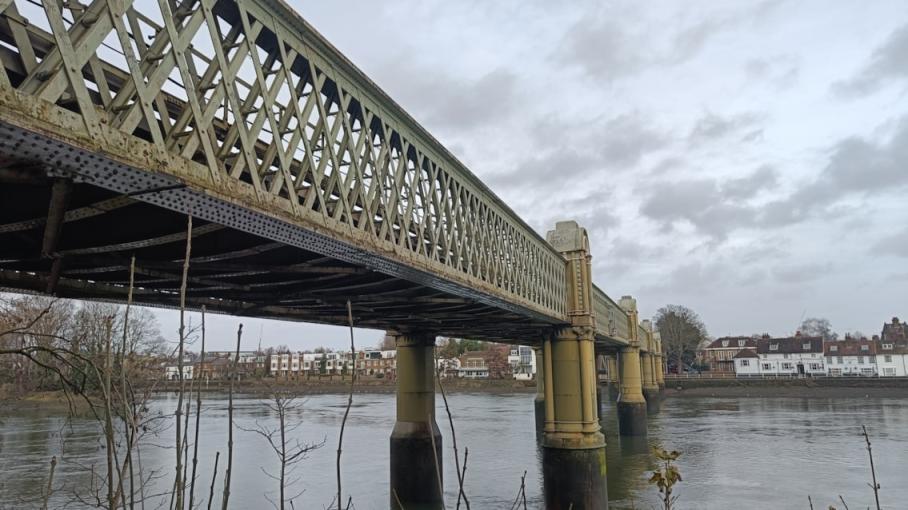
Essential engineering works on Kew railway bridge have led to weekend closures throughout September, affecting District line and overground services between Chiswick and Richmond. The final phase is scheduled for 5-6 October, with engineers replacing over 570 wheel timbers to enhance safety and reliability.
The Kew railway bridge, a Grade II listed structure, has been undergoing significant maintenance to replace its ageing railway timbers. This has resulted in the suspension of District line services between Chiswick and Richmond on weekends throughout September. Additionally, overground train services have been halted for the entire month. The engineering team plans to conclude their work on the weekend of 5-6 October, after which normal train and tube services are expected to resume. During this final weekend, there will be no London Overground service between Richmond and South Acton and no District line service between Richmond and Turnham Green.
The maintenance involves replacing more than 570 wheel timbers, which are crucial for holding the rails in place across the entire length of the bridge on both lines. According to sources, the existing wheel timbers, over 25 years old, are in poor condition, increasing the likelihood of track faults and subsequent delays for passengers. The Kew railway bridge supports both the London Overground's Richmond-Stratford line and the District line. This section of the railway is heavily utilised and has experienced increased disruptions recently. Network Rail and Transport for London are collaborating to minimise these delays.
The new wheel timbers are crafted from a more durable material that requires less maintenance and boasts a longer lifespan than traditional timbers. As part of the project, engineers will also install new rails near the bridge, replacing worn-out sections. Alongside the bridge works, teams are seizing the opportunity to conduct additional targeted maintenance. This includes enhancing train detection systems, replacing points at Gunnersbury and Richmond, upgrading signals at Richmond, and trimming vegetation to improve signal visibility for train drivers. These efforts aim to reduce the risk of flooding at Gunnersbury and minimise the chance of obstructions on the line.
Network Rail has stated that all these measures will help decrease the likelihood of faults occurring with these critical infrastructure components, thereby improving reliability and performance for passengers. Simon Milburn, Network Rail Anglia's infrastructure director, emphasised the importance of replacing the deteriorating wheel timbers on Kew railway bridge to ensure the safe and reliable operation of trains over the River Thames. He noted that this essential work would preserve the heritage structure's role as a vital part of these busy railway lines. The closure also provides an opportunity to perform other maintenance tasks to enhance service reliability for customers.
The new sleepers being installed are made from fibre-reinforced foamed urethane (FFU), a material known for its durability, extended service life, and ease of repair. FFU sleepers can also be repurposed or recycled at the end of their service life, making them an environmentally friendly choice. Beyond the specific closure of Kew Railway Bridge for these works, the District Line has experienced numerous stoppages, leading to reduced services over recent months.
In July, Liberal Democrat MP for Richmond Park, Sarah Olney, along with Liberal Democrat Member for the London Assembly for the South West, Gareth Roberts, who represents the Chiswick area, reached out to London Mayor Sadiq Khan for assistance. They sought the Mayor's intervention to address the ongoing disruptions and improve the reliability of services for commuters.
The Kew railway bridge, with its historical significance and strategic location, plays a crucial role in the transport network. The current maintenance efforts are not only necessary for preserving the bridge's structural integrity but also for ensuring the safety and efficiency of the railway services it supports. The collaboration between Network Rail and Transport for London highlights the importance of coordinated efforts in maintaining and upgrading critical infrastructure.
As the final weekend of closures approaches, commuters are advised to plan their journeys accordingly and consider alternative routes. The completion of these works promises to bring improved service reliability and reduced delays, benefiting passengers and the broader community. The investment in durable materials and comprehensive maintenance reflects a commitment to enhancing the long-term performance of the railway network.
In the broader context, the ongoing maintenance and upgrades to the Kew railway bridge and surrounding infrastructure underscore the challenges faced by urban transport systems. Balancing the preservation of historical structures with the demands of modern transportation requires careful planning and execution. The efforts to improve the reliability and efficiency of services are vital for supporting the region's economic and social activities.
As the project nears completion, the focus will shift to monitoring the performance of the newly installed components and ensuring that the anticipated benefits are realised. The lessons learned from this project may also inform future maintenance and upgrade initiatives across the railway network, contributing to the continuous improvement of transport services in the region.
Travel
Kew Railway Bridge Repairs Disrupt Services Until Early October
Essential engineering works on Kew railway bridge have led to weekend closures throughout September, affecting District line and overground services between Chiswick and Richmond. The final phase is scheduled for 5-6 October.




Comments (0)
You must be logged in to post comments.
Don't have an account? Register here
No comments yet. Be the first to share your thoughts!